Google makes thousands of changes every year, but this time the updates rolled out in 2026 are more direct and more demanding. These updates decide which businesses appear online and which ones disappear quietly.
For business owners, this means one thing, your website now directly affects whether customers find you or your competitors.
1. User Experience Is Now a Major Ranking Factor
Google focuses heavily on how visitors experience your website, including its website design. It checks how fast your site loads, whether it works well on mobile phones, how easy it is to read, and how long visitors stay on your website or specific pages.
If a website is slow, hard to use, or confusing due to poor design or structure, most people leave within seconds. When this happens often, Google assumes the website is not helpful and lowers its ranking.
Example scenario for User Experience as Ranking Factor:
A customer searches for a ‘cleaning service’ on their phone and clicks your website. If the page takes too long to load, the text is small or the menu is hard to use, the customer leaves and clicks another business. Google records this behaviour. When many users do the same, Google pushes your website down the search results, even though your service quality may be excellent.

2. Content Quality Matters More Than Quantity
The focus now is on how helpful your content is and not how much of it you publish. Websites with many short, generic pages or copied information no longer perform well. This includes low-quality AI content that does not add real value or answer customer questions clearly.
High-quality content explains your services in a simple, honest way and helps visitors make decisions. When people spend time reading your pages and find useful answers, Google treats this as a strong signal that your website deserves higher visibility.
Example scenario for Content Quality Matters:
A business publishes 40 blog posts that all repeat the same general information. Visitors click one page, realise it offers nothing new, and leave.
Another business publishes only 6 pages, but each one clearly explains services, pricing and common customer questions. Google sees better engagement on the second website and ranks it higher.
3. Google Needs to Understand Your Business/Website Clearly
Google wants to confidently know what your business does or what your website is all about before even it can recommend it to users. If your website is unclear, too broad, or inconsistent, Google struggles to match your business with the right searches or even placing you to the right audience.
Clear service descriptions, visible contact details, location or service areas and consistent branding help Google trust your business. When your website clearly explains who you serve and what you offer, Google can send the right customers your way.
Example scenario on how Google should Understand Your Business/Website:
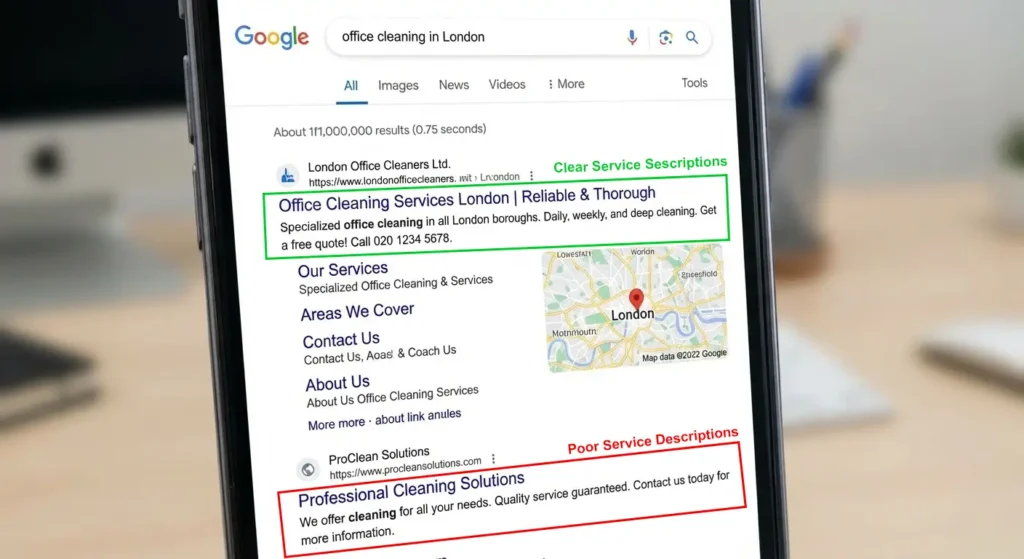
A customer searches for “office cleaning in London” One website clearly states office cleaning services, service areas and contact details. Another website uses generic language like “professional cleaning solutions” with no location or clear services. Google ranks the first business higher because it understands it better.
4. Mobile Performance and Local Visibility Are Very Important
The mobile version of your website is the main version. Most people search for businesses using their mobile phones. Google now looks at the mobile version of your website first, not the desktop version. If your website loads slowly, the text is hard to read or buttons are difficult to tap on a phone, poor website optimisation and website development can reduce your visibility.
Google also pays attention to location. Even if you do not have a physical shop, Google wants to show nearby businesses to users. Clear location information on your website and an active Google Business Profile help Google connect your business with local customers.
5. Regular Updates Signal a Healthy Website
Google prefers websites that are active and well maintained. When a website is updated regularly, Google sees it as a sign that the business is still operating, reliable and paying attention to customers. Updates do not have to be frequent, but they should be consistent.
Websites that are left unchanged for a long time often lose trust. Outdated information, broken links, old content or inactive pages signal neglect. When Google notices this, it slowly reduces the website’s visibility in search results.
Example scenario on how regular website updates are important:
A business updates its website every few months by refreshing service pages, adding new content, or updating contact details. Another business has not updated its website in years. Google continues to rank the active website higher because it appears current and trustworthy.
Want to know how your website is doing? I offer a free website audit to check how it performs with the latest Google updates. Contact me and we’ll get started.
